

%201.svg "cancel (1) 1")

.png?width=46&height=35&name=Group%20(2).png)



Australia’s hydrogen sector is entering a more selective phase. After several years in which hydrogen was promoted as a potential solution across transport, power, industry and exports, rising costs and slower project development are forcing a sharper focus on where it can deliver the most value. Rather than backing hydrogen across every possible use case, governments and investors are increasingly focusing on applications where there are few practical alternatives.For CSIRO Chief Research Consultant, Low Emission Energy, Dr Patrick Hartley, that shift reflects a broader international recalibration.
“The reductions in the cost of producing hydrogen at scale which many anticipated have not yet been realised, leading to a global moderation in the expectations and hype of recent years,” Hartley told Energy Insights.
“As a result, hydrogen is no longer seen as the ‘silver bullet’ for decarbonising a diverse range of our energy needs.”
The International Energy Agency’s (IEA) Global Hydrogen Review 2026 points in the same direction. Its pipeline of announced low-emissions hydrogen production for 2030 has fallen to 27 million tonnes a year, largely because of delays and cancellations. Globally, low-emissions hydrogen production grew by 20% in 2025, albeit from a relatively small base.
Where hydrogen still makes sense
Rather than disappearing from the transition, hydrogen is increasingly being targeted at sectors where direct electrification is difficult, or where hydrogen is already used as a feedstock.
Hartley identifies low-carbon liquid fuels and ammonia, along with reducing fossil fuel use in hard-to-abate industries such as steelmaking, as among the more prospective applications.
That is consistent with the IEA’s latest assessment. Around 80% of production from projects the IEA considers more likely to be operating by 2030 is targeted at chemicals, refining and low-emissions hydrogen-based fuels.
Australia is seeing the same narrowing of the field. Geoscience Australia’s 2026 assessment counted 76 announced clean hydrogen projects at the end of 2025, down from 90 a year earlier. Of those, 17 were operating, 11 under construction and 48 in feasibility or development.
Australia is seeing selective investment where hydrogen can be integrated into existing industrial demand. Orica has committed to the almost $400 million Hunter Valley Hydrogen Hub at Kooragang Island, which will use a 50 MW electrolyser to produce about 4,700 tonnes of renewable hydrogen a year for the company’s adjacent ammonia operations, with construction due to begin in 2026 and start-up targeted for early 2029.
The project is notable because Orica is effectively its own customer for the hydrogen, reducing offtake risk, although the economics still rely in part on government support through the Hydrogen Headstart program.
The challenge is no longer only whether hydrogen can be produced, but whether it can be produced, transported and sold at a price customers are willing to pay. The IEA says high costs, uncertain demand, complex regulation and insufficient infrastructure continue to slow deployment. Only around 20% of the volumes covered by new low-emissions hydrogen offtake agreements signed in 2025 were backed by firm contractual commitments. These products could support decarbonisation in areas such as shipping, aviation and fertiliser production.
Signs of scale overseas
For Australia, these overseas developments matter because they indicate where demand, infrastructure and policy support are beginning to converge.
Hartley nevertheless cautions against interpreting the smaller project pipeline as a lack of progress.
In Europe, Shell’s 200 MW Holland Hydrogen 1 electrolyser is under construction in Rotterdam, with commissioning expected to begin in late 2026 and production ramp-up planned for 2027. Germany’s EWE is building a 320 MW electrolyser at Emden, targeting first production in late 2027.
Dedicated infrastructure is important because hydrogen cannot simply be scaled through production alone; it also requires transport, storage and end-user connections. The Netherlands commissioned the first 32 kilometres of its national hydrogen network in May, while the proposed BarMar pipeline between Barcelona and Marseille entered front-end engineering design in July.
China is also moving ahead with larger integrated projects, particularly where hydrogen production is linked to ammonia and methanol. The first phase of the Songyuan Hydrogen Energy Industrial Park in Jilin province began operations in December 2025 and is designed to produce 45,000 tonnes of green hydrogen annually, alongside green ammonia and methanol.
In India, government-backed hydrogen tenders are being complemented by long-term demand agreements, including Uniper’s agreement to purchase up to 500,000 tonnes a year of renewable ammonia from AM Green from as early as 2028.
Could the next pathway lie underground?
Natural geological hydrogen refers to hydrogen generated through naturally occurring subsurface processes, while orange hydrogen involves deliberately stimulating reactions underground.
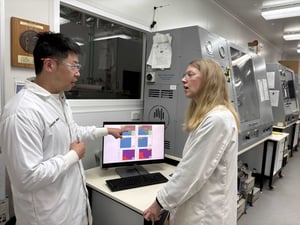
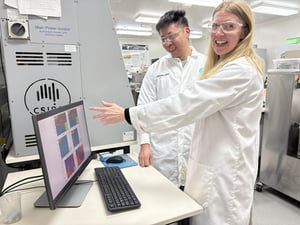
The search for cheaper hydrogen is also expanding beyond electrolysis. Hartley points to growing interest in naturally occurring geological hydrogen, which could in principle avoid much of the electricity input required to manufacture hydrogen.
CSIRO researchers are also examining a related but distinct pathway: “orange hydrogen”.
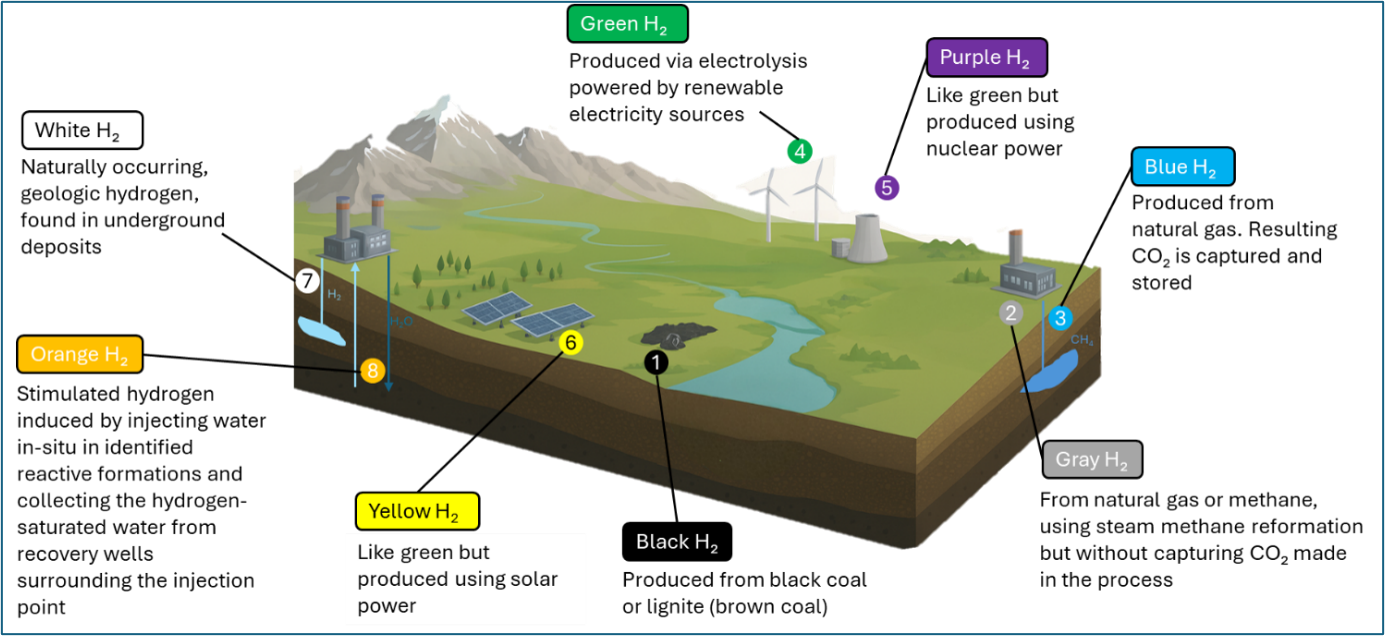
Recent modelling of the Yilgarn Craton in Western Australia explored whether injecting carbon dioxide-rich water into iron-rich rocks could stimulate hydrogen-producing water-rock reactions while also mineralising some carbon dioxide into stable carbonate minerals. In simple terms, the idea is to use certain underground rock formations as both a hydrogen-producing system and a potential carbon storage site.
The challenge is that the best conditions for producing hydrogen may not be the same as those for locking away carbon dioxide.
“However, the conditions that maximise hydrogen generation are not always the same conditions that maximise carbon storage. Understanding these trade-offs is essential if orange hydrogen is to become a practical energy solution,” said Dr Regina Sander.
The CSIRO research team included Dr Lingping Zeng, Dr Saeed Salimzadeh, Nicholas Lupton and Michael Camilleri.
The modelling found that higher temperatures favoured hydrogen generation, while carbon mineralisation performed best at around 150°C to 200°C under the modelled conditions. But the research remains early-stage. No commercial-scale orange hydrogen projects exist in Australia, and CSIRO says laboratory experiments, field trials and further geological assessment are still needed.
CSIRO says the formal program structure of its Hydrogen Industry Mission concluded in June 2026, although hydrogen expertise and research activity continue within the organisation.
That makes the next phase of Australia’s hydrogen sector more pragmatic than promotional. Success is likely to depend less on the number of projects announced, and more on whether individual projects can match credible demand, secure infrastructure and prove a cost advantage in specific hard-to-abate applications.
For Australia, the next test is not whether hydrogen can work, but where it can compete. The strongest opportunities will be those that secure customers, reach construction and cut emissions in areas where electrification is not enough.


.png)

Creating clarity during the energy transition.
Get a different perspective on energy with our monthly newsletter.
