

%201.svg "cancel (1) 1")

.png?width=46&height=35&name=Group%20(2).png)



Australia has no shortage of renewable energy projects on paper. The problem is getting them built.
A new Australian analysis has found the wind, solar and battery pipeline across the country’s main grids is already large enough in aggregate to meet the new capacity needed to meet the 2030 renewable energy target — but only a fraction has made it into construction.The Australian Renewable Energy Scorecard, released by the Institute for Energy Economics and Financial Analysis (IEEFA) and Green Energy Markets on 16 September, tracks wind, solar and battery projects through development, approval, contracting and construction.
Using project data to 30 June 2026, the assessment compares the pipeline with the new capacity needed for the federal government’s target for renewables to supply 82% of electricity in Australia’s principal grids by 2030. Its scope covers the National Electricity Market and Western Australia’s South West Interconnected System, together accounting for around 85% of national electricity consumption.
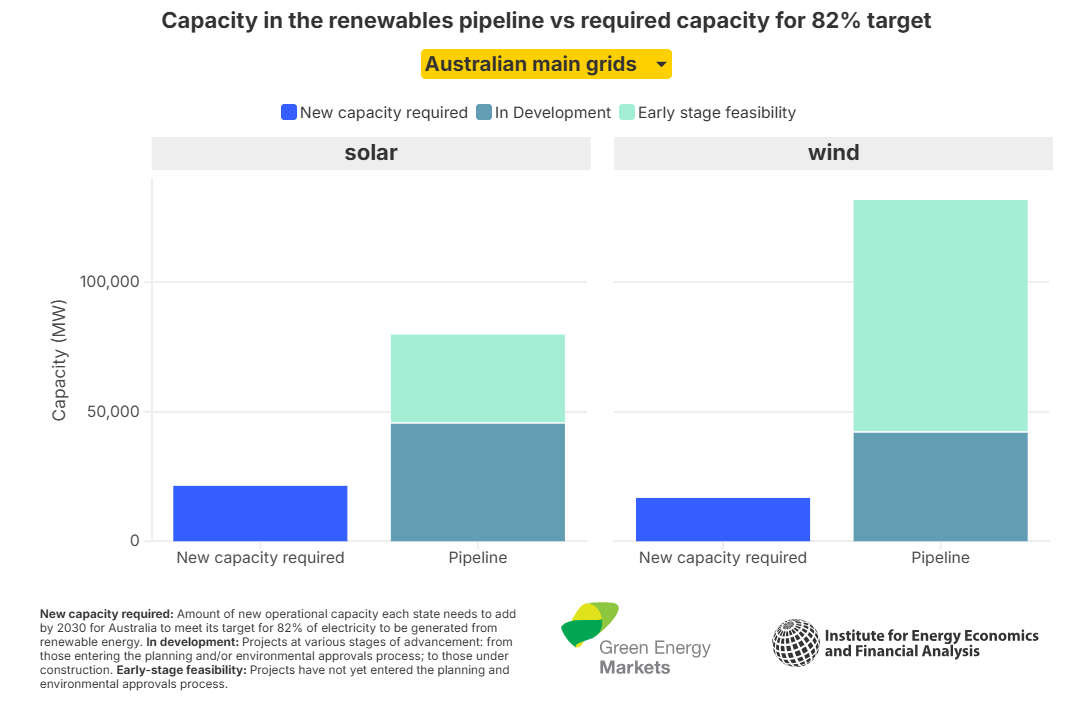
Across those grids, wind and solar projects already in development exceed the aggregate new capacity needed to meet the target, while battery projects in development exceed estimated requirements in every state assessed.
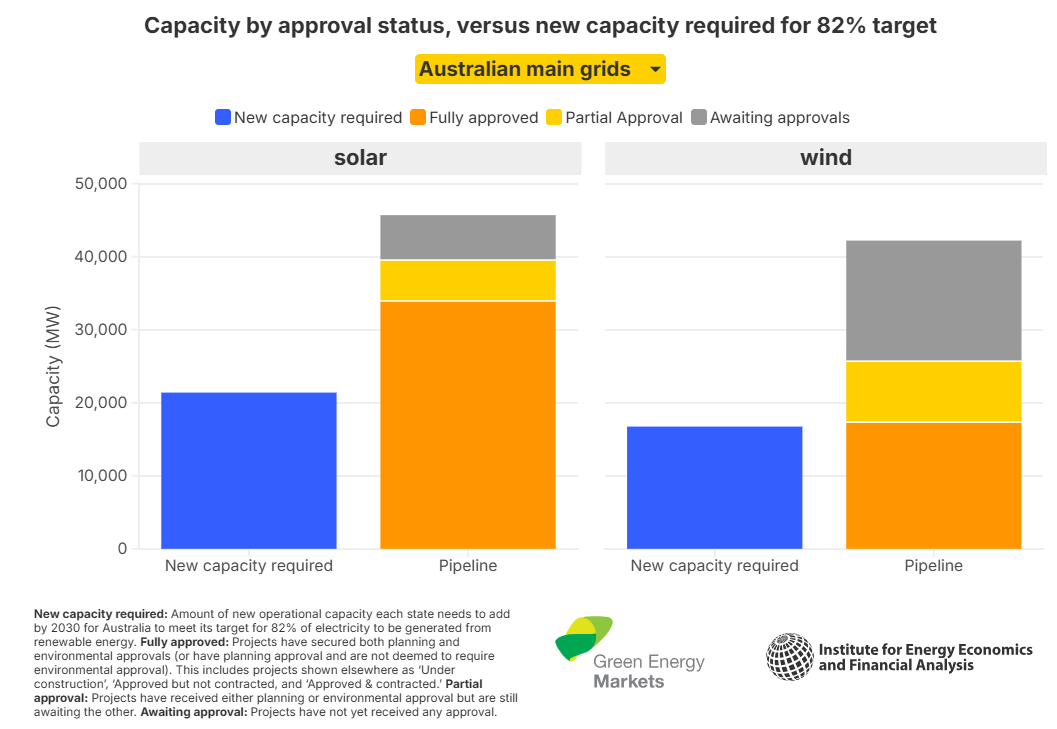
The picture changes sharply at the construction stage.
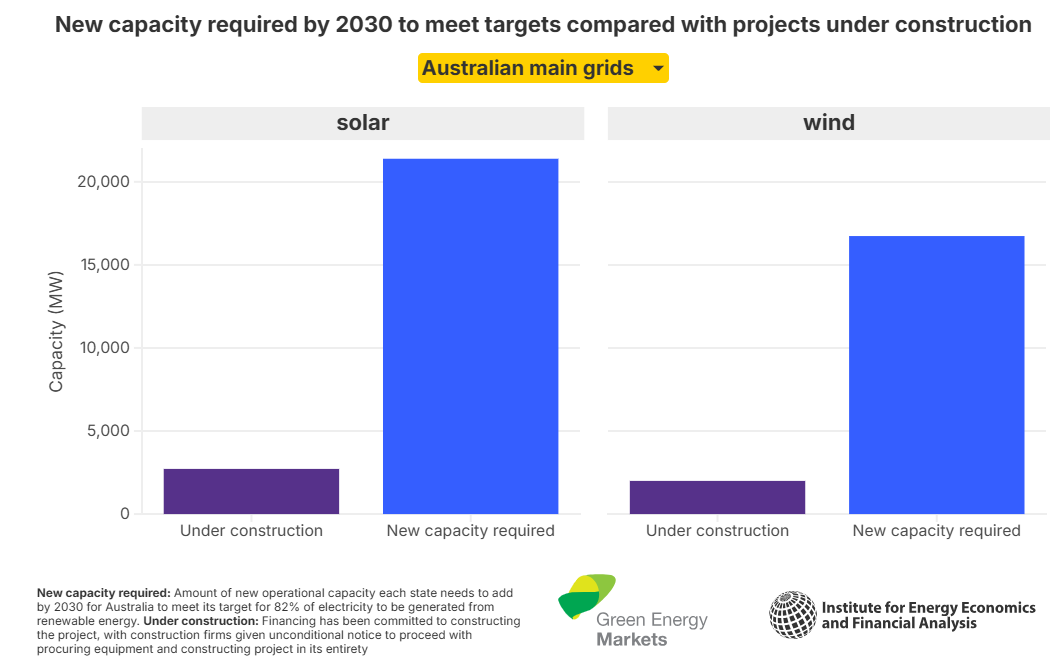
For wind and solar combined, projects being built amount to less than 10% of the additional capacity needed by 2030 in NSW, Victoria, Tasmania and Western Australia. South Australia has 23% of its targeted new capacity under construction and Queensland 32%.
Large-scale batteries show a similar gap. Apart from Tasmania, where the scorecard projects no additional battery requirement because of its large share of hydro generation, battery projects at the construction stage represent only 18% to 28% of the capacity needs by 2030 across the states assessed.
IEEFA lead analyst for Australian electricity Johanna Bowyer said “projects under construction still fall far short of what must be built by 2030”.

The findings point to several hurdles between development and construction, including approvals, grid connection and transmission access, financing and final investment decisions. But its analysis identifies contracting as a particularly significant blockage for wind and solar.
Only 6% of fully approved wind and solar projects across Australia’s main grids have also secured a long-term power purchase agreement (PPA). Such contracts generally commit a customer to purchasing a significant portion of a project’s output for at least five years, reducing revenue uncertainty and making projects easier to finance.
Green Energy Markets director of analysis and advisory Tristan Edis said: “Only a small share of fully approved projects have secured contracts.”

The low proportion of contracted projects also raises questions about whether government underwriting alone is sufficient to bring projects to financial close.
Close to 25,500 MW of wind and solar capacity has received underwriting through the federal Capacity Investment Scheme or NSW government schemes. Of that, 9,707 MW is still awaiting one or more approvals. 10,794 MW has approval but neither a PPA nor construction underway.
Just 2,811 MW has reached construction or commenced operations after receiving an underwriting agreement.
The authors caution that the analysis did not include grid connection or transmission constraints because sufficient data was not available, meaning those factors may also be delaying projects.
The gap has significant investment implications. Renewable and battery projects already at the construction stage are estimated to be generating around $6 billion in direct domestic construction investment and 15,600 job-years of work. Moving the remaining fully approved pipeline into construction could generate around $44 billion in additional domestic investment and 127,000 job-years.
The first edition of the scorecard therefore suggests that Australia’s near-term challenge is no longer primarily attracting project proposals, but converting a mature pipeline into financed, contracted and buildable assets, quickly enough for them to be operating by 2030.


.png)

Creating clarity during the energy transition.
Get a different perspective on energy with our monthly newsletter.
