

%201.svg "cancel (1) 1")

.png?width=46&height=35&name=Group%20(2).png)



Since receiving final sign-off in late May to operate at full capacity, RWE’s Limondale battery has provided an early operating example of a storage duration that is becoming increasingly relevant to Australia’s electricity system. Longer-duration storage can help shift surplus solar generation into higher-demand periods and support extended evening and morning peaks that shorter-duration batteries may not be able to cover.Located near Balranald in south-west New South Wales, Limondale has a registered maximum discharge output of 50 MW and at least 400 MWh of storage. It comprises 144 Tesla Megapacks and is registered to charge at up to 100 MW. The NSW Government describes it as Australia’s first eight-hour battery and, at its official opening in June, the longest-duration battery operating in the country.
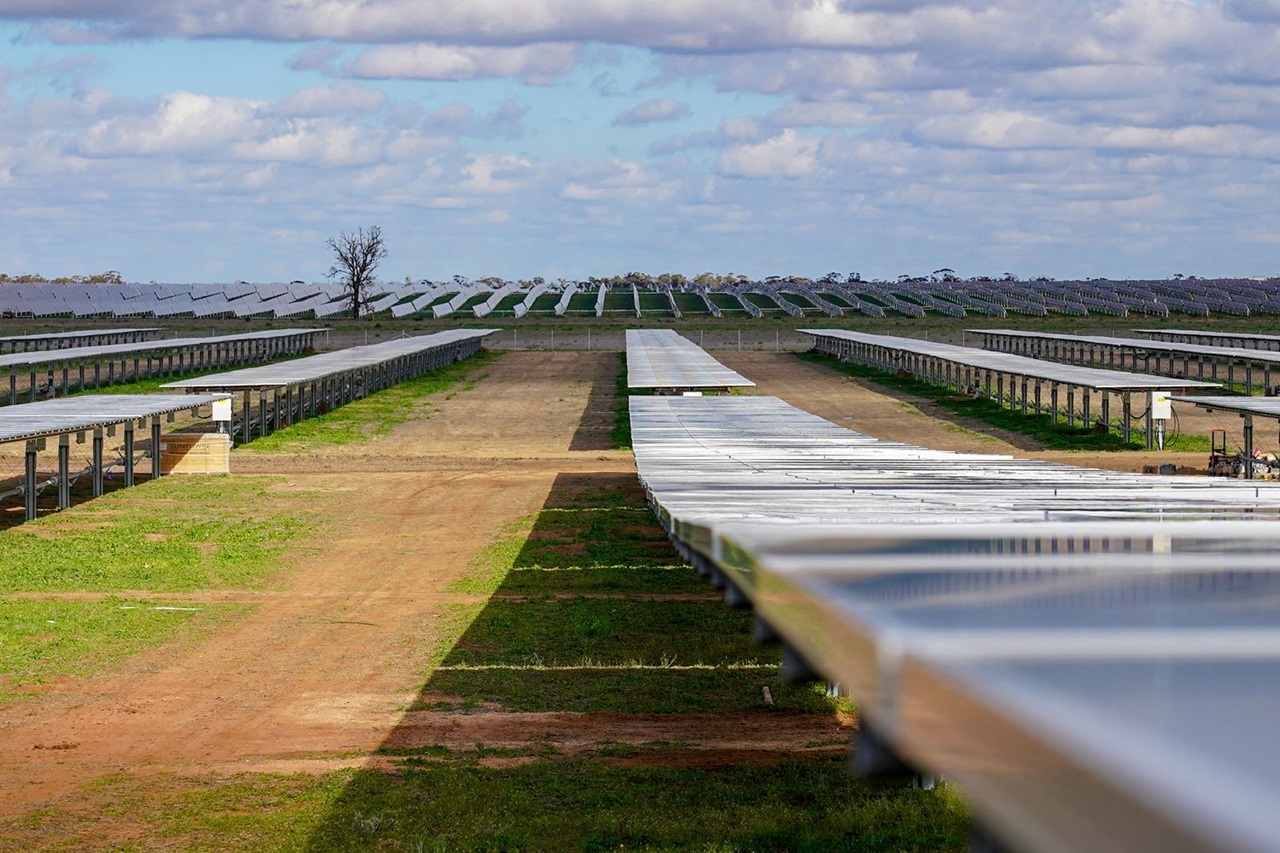
Limondale Solar Farm RWE
For the broader storage debate, the important distinction is between power and energy. A battery’s megawatt rating determines how much power it can deliver at a given time; its megawatt-hour capacity helps determine how long that output can be sustained. Limondale’s 50 MW / 400 MWh configuration illustrates that distinction: its power rating is relatively modest, but its energy capacity allows it to discharge for up to eight hours.
That distinction is becoming more important as Australia’s battery pipeline grows.
AEMO’s latest connections scorecard shows batteries accounted for 52% of the 75.4 GW of generation and storage capacity progressing through the National Electricity Market connections pipeline.
Under AEMO’s 2026 Integrated System Plan (ISP), storage capable of dispatching continuously for four to 12 hours is classified as “medium storage”, with batteries projected to be its primary source.
RWE says changing market conditions are one factor behind the move towards longer durations.
“There was a period when one-hour batteries delivered the greatest value because they aligned well with relatively short peak demand periods and provided a strong commercial return in both the energy and FCAS markets,” an RWE Renewables Australia spokesperson told Energy Insights.
RWE attributes the shift to longer peak-pricing periods and what it describes as an oversupplied frequency control ancillary services (FCAS) market.
Recent AEMO data independently confirms some of the wider market context. In the June quarter, growing grid-scale battery capacity more than tripled the volume of energy shifted from high-solar daytime periods into the evening peak compared with a year earlier. Battery charging and discharging also set NEM spot prices in a combined 36% of dispatch intervals, up from 17% in Q2 2025.
At the same time, greater battery activity has not automatically translated into greater revenue. AEMO estimated FCAS revenue for NEM grid-scale batteries fell 51% year-on-year to $4.8 million in the June quarter. Net energy-arbitrage revenue fell 56% to $52.8 million as intraday price differences narrowed.
Those figures cover grid-scale batteries collectively rather than isolating longer-duration projects such as Limondale, but they underline the changing commercial environment in which new battery projects are operating.
What eight hours changes in practice
For Limondale, RWE says the additional duration has broadened the range of conditions the battery can respond to.
During winter, the company says it observed periods of elevated prices extending overnight and into the morning peak, potentially allowing the battery to respond across periods that shorter-duration systems may not be able to fully cover if they have already discharged earlier in the day .
“The additional duration provides greater flexibility to adapt to changing system conditions and price events, rather than being constrained to a relatively narrow operating window,” the spokesperson said.
Where eight-hour batteries fit in the storage mix
Eight-hour batteries are only one part of the broader storage task facing the NEM.
The terminology differs between policy frameworks. Under the NSW Electricity Infrastructure Roadmap, eight-hour systems such as Limondale qualify as long-duration storage. AEMO’s ISP uses a different classification, placing storage capable of dispatching for four to 12 hours in its “medium storage” category, suitable for shifting substantial quantities of electricity into morning or evening peaks. It defines deep storage as capable of dispatching for more than 12 hours and assigns it a different role: helping cover prolonged renewable lulls and seasonal requirements.
In its 2026 ISP, AEMO projects the NEM would need about 35 GW of shallow and medium grid-scale storage by 2050, as well as about 5 GW of new deep storage delivered by pumped hydro, in addition to the existing hydro-electric fleet.
RWE similarly argues that eight-hour batteries should be viewed as one part of the system rather than a replacement for every form of firm capacity. It sees their strongest role in shifting energy within the day, while pumped hydro, gas and other resources provide support through longer supply shortfalls.
From first project to a larger pipeline
Limondale’s eight-hour configuration was influenced by NSW policy incentives as well as expectations about future market value. The project was selected in the first NSW Electricity Infrastructure Roadmap tender for long-duration storage and was the first project awarded a Long Duration Storage Long-Term Energy Service Agreement.
The NSW long-duration storage pipeline has expanded substantially since then. Most recently, six battery projects awarded agreements in February 2026 totalled 1,171 MW and 11,980 MWh of storage. The NSW Government says each is capable of continuously dispatching stored electricity for more than eight hours.
Asked whether RWE would still choose an eight-hour configuration if it were making the Limondale investment decision today, the spokesperson replied: “We would build the same project.”
One project cannot establish the economics of long-duration batteries across the NEM. But Limondale is now operating in a market that is moving towards longer-duration storage. AEMO’s modelling, connection data and the NSW project pipeline all point to a greater role for batteries that can sustain output for longer.
Australia’s battery build-out, in other words, is now as much a question of megawatt-hours as well as megawatts.


.png)

Creating clarity during the energy transition.
Get a different perspective on energy with our monthly newsletter.
