

%201.svg "cancel (1) 1")

.png?width=46&height=35&name=Group%20(2).png)



Australia’s electricity market is entering a new phase, with batteries reshaping how renewable energy is stored, dispatched and priced across the grid.
According to the latest Quarterly Energy Dynamics (QED) report from Australian Energy Market Operator (AEMO), renewable generation continued expanding its share of the National Electricity Market (NEM) during the first quarter of 2026, while coal and gas generation continued to decline.
The report found renewables supplied 46.5% of NEM generation during the March quarter — the highest first-quarter share on record — driven by stronger wind and solar output alongside rapid growth in both household and grid-scale batteries.
At the same time, average wholesale electricity prices fell 12% year-on-year to $73/MWh, despite summer heat events and high underlying demand.
Batteries emerge as a major market force
A key trend identified in the report was the growing influence of batteries on market operations and price formation.
AEMO said batteries more than tripled the amount of energy shifted from daytime into the evening during the quarter, with evening peak discharge rising by 818 MW to 1,115 MW as they absorbed more surplus solar generation in the middle of the day.
The change was supported by 4,445 MW of new large-scale battery capacity added over the previous 12 months, more than doubling total installed battery capacity across the NEM.
AEMO Executive General Manager Policy and Corporate Affairs Violette Mouchaileh said the market was undergoing structural change.


“The significant increase in large‑scale and household battery capacity is changing how electricity is produced, consumed and priced across the day,” Mouchaileh said.
“Grid-scale batteries are increasingly absorbing excess renewable energy during the day and shifting it into the market during evening peaks, helping moderate prices during high-demand periods.”
The findings also suggest batteries are reducing reliance on traditional peaking generation sources.
According to AEMO, batteries became the most frequent price-setting technology during the quarter, setting prices in approximately 32% of all trading intervals across the NEM.
The trend points to a significant shift in how evening demand is being managed, with batteries increasingly displacing gas and hydro generation during evening peaks.
Coal and gas generation continue to decline
The report found coal-fired generation fell to a new first-quarter low, while gas-powered generation reached its lowest quarterly average since 1999.
At the same time:
-
Grid-scale solar generation averaged 2,706 MW, up 13% year-on-year
-
Wind generation averaged 3,845 MW
-
Queensland recorded particularly strong wind growth as new projects reached full output
-
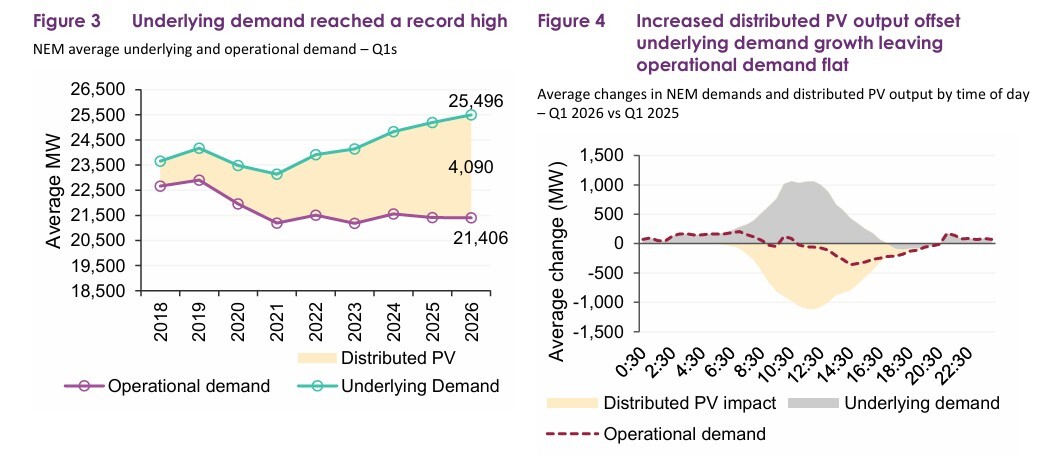
Underlying electricity demand reached a record 25,496 MW
However, AEMO said strong rooftop solar output offset much of this increase in demand, leaving operational demand broadly unchanged.
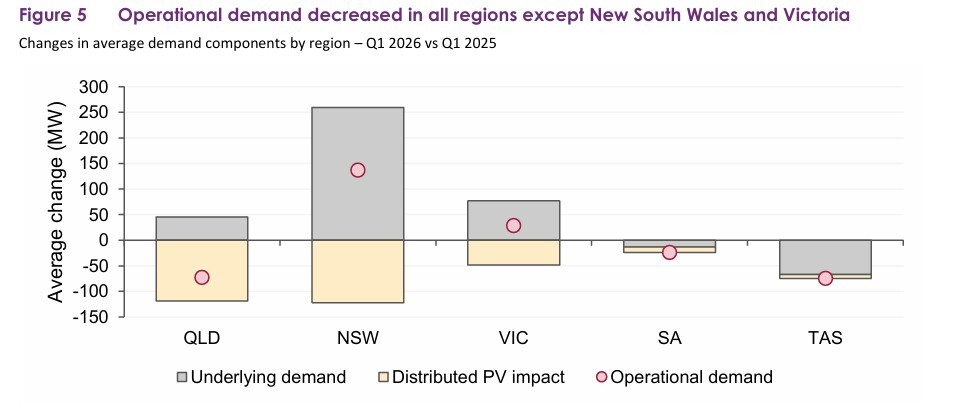
The data highlights how distributed energy resources are continuing to reshape the operational profile of the grid, particularly during daytime periods where rooftop solar generation remains exceptionally strong.
Data centres emerge as a new demand challenge
For the first time, AEMO’s Quarterly Energy Dynamics report also included insights into data centre connections, which are emerging as a growing demand consideration.
The report identified 11 large-scale data centre projects greater than 5 MW currently moving through the connection process, representing a combined 5.4 GW of maximum demand.
Around 60% of this capacity is located in New South Wales and 40% in Victoria.
Most projects remain in early development phases, with seven projects representing 4.1 GW currently in the application stage.
Growing electricity demand from large-scale data centres is likely to become an important issue for the energy sector as artificial intelligence, cloud computing and digital infrastructure continue expanding across Australia.
The report suggests these loads could become a major consideration for future transmission planning, reliability management and generation investment decisions.
Gas prices fall despite geopolitical uncertainty
In the east coast gas market, average wholesale gas prices fell to $10.61/GJ during the quarter (down 20% year-on-year).
March prices also reached a four-year low of $9.22/GJ.
AEMO attributed the decline partly to weaker gas demand from electricity generation and lower Queensland LNG exports.
Mouchaileh said domestic market conditions remained resilient despite international pressures.
“Despite elevated international liquefied natural gas (LNG) prices linked to geopolitical uncertainty, domestic gas prices fell, supported by lower gas demand for electricity generation and reduced Queensland LNG exports.”
Western Australia sees similar transition trends
The report found similar dynamics emerging in Western Australia’s Wholesale Electricity Market (WEM), where renewables supplied 46.1% of generation during Q1 2026, up from 40.8% a year earlier.
Growth was supported by stronger wind output, increased distributed solar generation and higher biomass generation.
More than 1,025 MW/4,100 MWh of new battery capacity was commissioned since the end of Q1 2025.
Mouchaileh said the market was undergoing comparable structural change to the east coast.
“Similar to the NEM, the growth in renewables and grid‑scale batteries – with more than 1,000 MW of battery capacity added in the past year – is changing the dynamics of Western Australia’s WEM,” Mouchaileh said.
Transition momentum continues — but challenges remain
While the report points to accelerating renewable and battery integration across Australia’s electricity system, AEMO also noted ongoing external pressures affecting the broader energy market.
In Western Australia, reduced access to diesel and higher diesel costs impacted market participants and the wider economy.
However, Mouchaileh said overall market conditions remained stable heading into winter.
“While impacts from reduced access and higher costs for diesel are having an impact on market participants, consumers and the economy more broadly, Australia’s electricity and gas markets remain resilient, with strong gas storage levels heading into winter. AEMO continues to support industry and advise governments.”


.png)

Creating clarity during the energy transition.
Get a different perspective on energy with our monthly newsletter.
