

%201.svg "cancel (1) 1")

.png?width=46&height=35&name=Group%20(2).png)



Australia remains one of the world’s largest energy exporters, but its export earnings are still heavily concentrated in fossil fuels. Emerging low-carbon industries are growing, but remain far from comparable commercial scale. This dependence on fossil-fuel exports leaves the economy exposed to resource decline, changing international demand and the accelerating global shift away from unabated fossil fuels.
“The country exported around eight times more energy than it imported”
Energy commodity exports generated $180 billion in 2023–24, accounting for about 27% of Australia’s total export earnings. The country exported around eight times more energy than it imported and ranked as the world’s second-largest coal exporter, third-largest liquefied natural gas exporter and fourth-largest uranium producer.
However, the latest national assessment shows Australia’s total demonstrated non-renewable energy resources have declined by 3.2% since 2018. Conventional oil and gas resources are falling, while hydrogen, carbon capture and storage and geothermal energy remain at markedly earlier stages of development.
The figures are contained in Geoscience Australia’s Australia’s Energy Commodity Resources 2026, which assesses non-renewable resources through to the end of 2024 and low-carbon technologies through to the end of 2025.
Fossil fuels continue to dominate the export mix
Australia was the eighth-largest primary energy producer globally in 2024, responsible for 2.7% of global energy commodity production.
However, conventional gas resources declined 4.8% during 2024 as production continued to outpace the discovery of new reserves. At current production rates, Australia’s conventional gas reserves have an estimated life of 15 years, while coal seam gas reserves have an estimated life of 17 years.
The figures point to a tightening domestic resource base, although reserve life alone does not determine Australia’s future energy security. The pace of electrification, improvements in energy efficiency and the development of alternatives to gas and liquid fuels will also shape future demand.
“crude reserves have an estimated remaining life of eight years”
The outlook for oil is more constrained. Australia’s crude oil resources fell 15% in 2024 and crude reserves have an estimated remaining life of eight years at today’s rate of output.
While Australia is a major exporter of coal, gas and uranium, it imports about 95% of its crude oil and refined petroleum products. Imports meet 79% of refined product consumption, highlighting a sharp distinction between Australia’s strength as an exporter of coal, gas and uranium and its exposure to disruptions in liquid fuel supply.
Reducing that exposure will require more than finding new oil reserves. Electrification, public and active transport, fuel-efficiency improvements and alternatives for aviation, shipping and heavy transport will also be central to lowering Australia’s reliance on imported petroleum.
Since 2018, total oil assets have declined 9.5% and gas has fallen 11.9%. Crude oil alone has fallen by more than 40%, driven partly by offshore fields reaching the end of their productive lives.
Investment remains tied to the existing energy system
Private energy exploration expenditure reached $1.81 billion in 2024, an increase of 25% from $1.45 billion in 2023.
fossil-fuel projects may be exposed to changing demand and climate policy
The continued flow of capital into Australia’s existing energy base highlights the tension between the country’s current export economy and its longer-term transition objectives. Long-lived fossil-fuel projects may be exposed to changing demand and climate policy, while also carrying the risk of locking in high-emissions infrastructure.
A total of 24 major energy projects, collectively valued at more than $42 billion, reached the committed stage.
Resources Minister Madeleine King said the assessment showed Australia was “well-positioned across energy resources, production and exports”.
“Australia’s energy exports are vital for the continued energy security of our regional partners as Australia and the world move toward net zero emissions by 2050,” she said.
However, geological estimates do not show how much coal and gas can be produced commercially over the longer term, or how future demand will be affected as regional trading partners pursue their own net-zero targets.
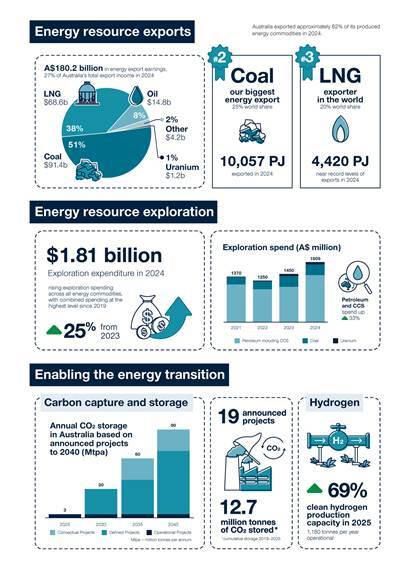
Australia also retains substantial coal and uranium. It supplies one-quarter of internationally traded coal and holds around one-third of the world’s known uranium. At 2024 production rates, its black coal reserves could support 165 years of production.
A 165-year reserve life says little, however, about whether demand for unabated coal will persist for anything approaching that period as electricity systems decarbonise.
The more important question is how demand, climate policy and competing technologies will affect their value over time.
Emerging alternatives remain immature
The report identifies hydrogen and carbon capture and storage (CCS) as important parts of Australia’s emerging low-carbon economy, but the data shows how few announced projects have reached commercial scale.
More than 50 companies were advancing approximately 76 hydrogen projects at the end of 2025. Of these, 17 were operating, 11 were under construction and 48 remained under development.
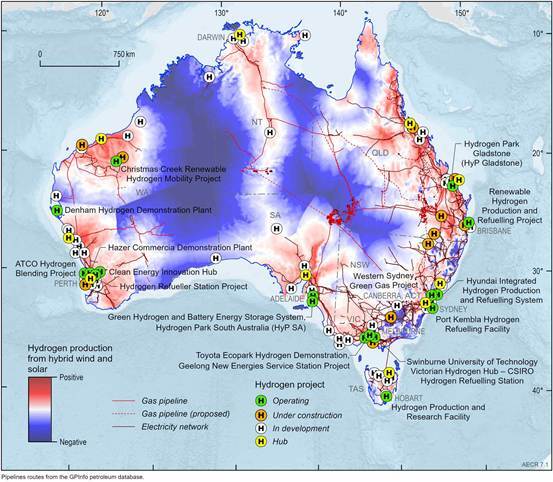
Hydrogen projects and proposed hydrogen hubs.
Operational clean hydrogen production capacity increased by 69% during the year, but reached only 1,180 tonnes per year as projects moved from pilot to demonstration scale.
High production costs, slow demand growth and project delays continue to weigh on near-term deployment.
CCS has progressed further, with two commercial-scale facilities operating and another 17 commercial carbon dioxide storage projects identified across Australia. The country’s reported carbon dioxide storage resources increased 47% in 2025 to 988 million tonnes, alongside an estimated 31 billion tonnes of sub-commercial theoretical storage resources.
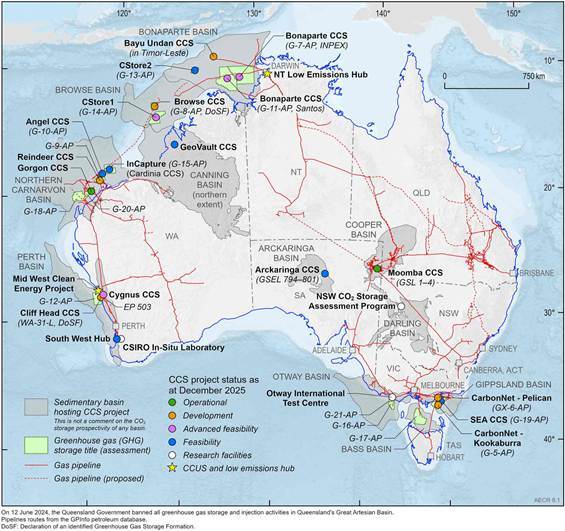
CCS Projects in their host sedimentary basin.
Converting that geological potential into emissions reductions will still depend on project performance, regulatory development, infrastructure and sufficient commercial demand.
The race to close the transition gap
Australia remains an energy heavyweight, but its export earnings are concentrated in fossil fuels whose long-term prospects will be shaped by decarbonisation, changing demand and, in some cases, declining resources.
The central challenge is not replacing every depleted oil or gas reserve. It is building commercially viable low-carbon industries quickly enough to diversify Australia’s export economy and sustain its influence in a changing global energy system.


.png)

Creating clarity during the energy transition.
Get a different perspective on energy with our monthly newsletter.
